

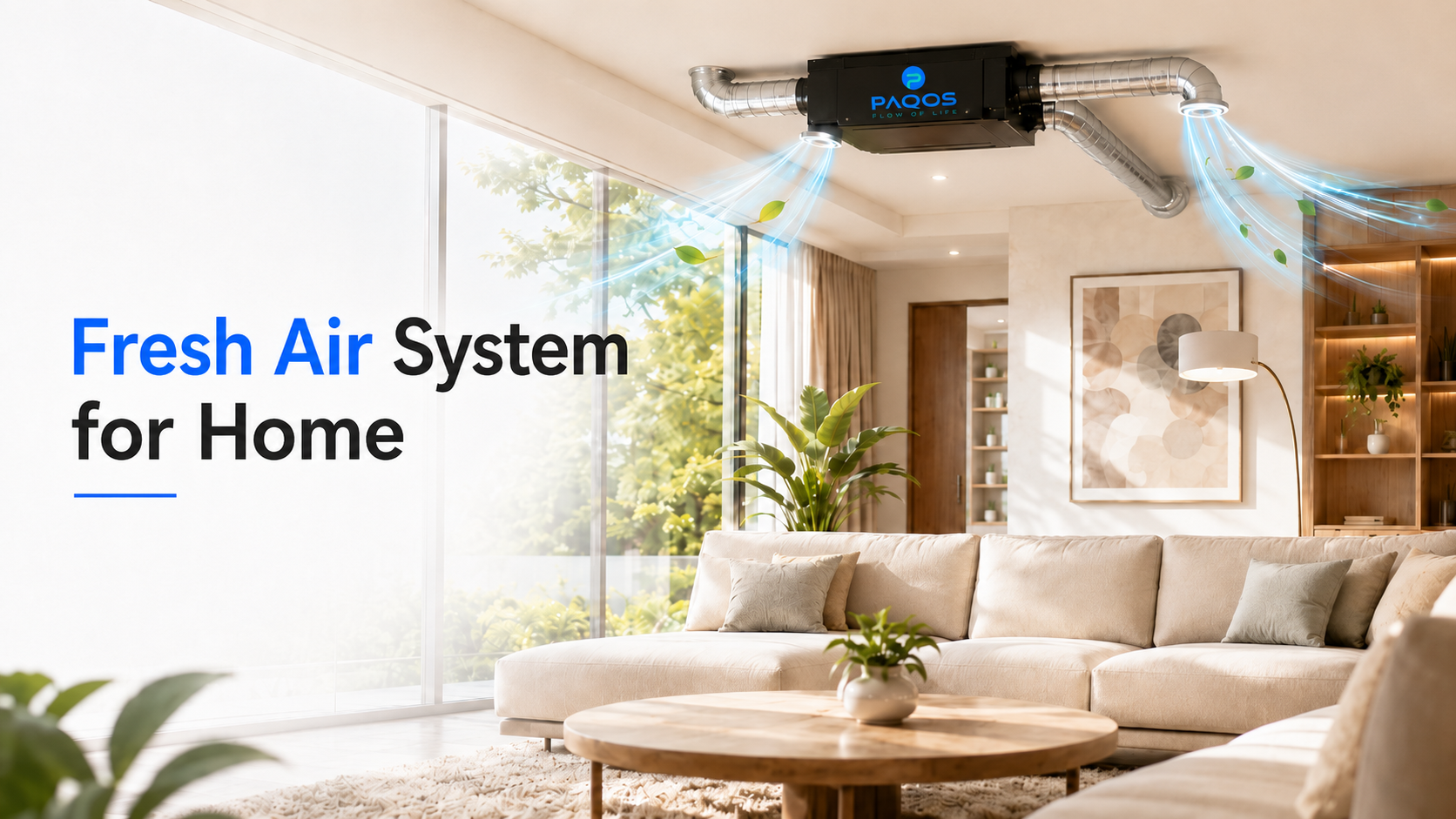
A Fresh Air System for Home provides a planned solution for introducing filtered outdoor air into closed and air-conditioned living spaces. Modern homes are designed for comfort, privacy, and energy efficiency. But closed windows, sealed walls, and continuously running air conditioners often leave indoor spaces feeling stale and uncomfortable. Poor natural airflow allows moisture, odors, and indoor pollutants to accumulate quietly—without residents ever realizing it. An Indoor Fresh Air System offers a planned, engineered solution that maintains continuous airflow and supports better indoor comfort throughout the year.
What Is an Indoor Fresh Air System and How Does It Work?
An Indoor Fresh Air System is a mechanically planned setup that introduces outdoor air into a home in a controlled and consistent manner. Depending on the system design, the incoming air passes through suitable filtration before being distributed to bedrooms, living rooms, and other frequently occupied spaces.
This is quite different from simply opening a window. An open window offers no control over the quality, volume, or direction of airflow. A properly designed system, by contrast, manages how outdoor air enters, how it moves through the space, and how stale indoor air is removed or diluted.
PAQOS describes well-planned fresh air and ventilation solutions as essential for comfortable indoor environments—particularly in airtight homes where natural air exchange is limited.
Why Do Modern Closed Homes Need Better Ventilation?
Several features of modern construction and lifestyle reduce natural airflow indoors:
- Tightly sealed doors and windows that minimize outdoor air leakage
- Long hours of air-conditioner use with windows kept shut
- Limited cross-ventilation, especially in apartments with only one open side
- Noise, dust, and outdoor pollution that make opening windows impractical
- Modular kitchens and enclosed bathrooms that trap odors and moisture
- Energy-efficient construction that reduces uncontrolled air movement between indoors and outdoors
According to the U.S. Environmental Protection Agency, buildings designed to minimize outdoor air leakage may experience higher indoor pollutant levels unless they include suitable mechanical ventilation. This is a pattern seen across modern homes in India, where residents keep windows closed year-round due to heat, dust, insects, and urban noise.
An Indoor Fresh Air System directly addresses this gap by introducing managed airflow without depending on open windows.
Signs That Your Home May Not Be Getting Enough Fresh Air
Before investing in a solution, it helps to recognize the problem. These are common signs that your home’s ventilation may be insufficient:
- Rooms feel stuffy or heavy after remaining closed for a few hours
- Cooking smells linger well after meals are done
- Musty odors in bedrooms or enclosed areas
- Condensation forming on interior window surfaces
- Bathrooms taking too long to dry after use
- Excessive indoor humidity that makes the space feel uncomfortable
- Indoor dust and odors returning quickly after cleaning
- Air feels noticeably stale after several hours of AC use
These are environmental and comfort signals—not medical diagnoses—but they point clearly to a ventilation gap that a home ventilation system can help address.
Why AC Rooms Still Need an Indoor Fresh Air System
This is one of the most common misconceptions among homeowners. A room air conditioner primarily cools and conditions the air already present inside the space. It controls temperature—and, depending on the unit, humidity—but it does not routinely bring in sufficient outdoor air.
Most standard split ACs recirculate the same indoor air. The result: a room that feels cool but remains stale, with odors, moisture, and airborne particles continuing to accumulate.
Opening windows is not always a practical solution. Heat, dust, outdoor pollution, insects, and noise make this unrealistic for large parts of the year. A dedicated Indoor Fresh Air System fills this gap by introducing and distributing planned fresh air separately from the cooling function. Cooling and ventilation serve different purposes—and both are needed for genuine indoor comfort.
What Is a Fresh Air System for Home?
For those looking to improve air circulation in closed rooms without compromising on temperature control, combining an AC with a fresh air ventilation system is the most complete approach.
How an Indoor Fresh Air System Brings Outside Air Indoors
The process is straightforward, though the exact design varies by property:
- Outdoor air enters through a planned intake point, positioned to draw from a clean, accessible location
- The incoming air passes through appropriate filtration, removing dust, particulate matter, and other airborne contaminants depending on the filter grade
- Ducts or vents distribute the filtered air to bedrooms, living areas, and other occupied spaces
- Stale indoor air is diluted or removed through exhaust points and ventilation outlets
- The system maintains consistent air exchange without requiring windows to remain open
The right design for an Indoor Fresh Air System depends on several factors: the size and layout of the home, the number of occupants, existing AC or HVAC infrastructure, available ducting routes and ceiling space, outdoor air conditions, and the required level of filtration. Selecting a system without assessing these variables often results in uneven airflow, unnecessary noise, or insufficient fresh air supply.
Benefits of an Indoor Fresh Air System for Modern Homes
Reduces the Feeling of Stale Air
Continuous, planned air exchange makes frequently occupied rooms feel fresher and more comfortable. The difference is noticeable—particularly in bedrooms and living rooms that remain closed for extended periods.
Helps Control Indoor Odors
Fresh airflow helps dilute odors from cooking, cleaning products, furniture off-gassing, and everyday household activity. Rather than masking smells with sprays or fresheners, the system addresses the root cause: insufficient air turnover.
Supports Moisture Management
Bathrooms, kitchens, and densely occupied rooms tend to accumulate excess moisture. Better ventilation assists in removing that moisture before it leads to condensation, damp surfaces, or long-term problems.
Improves Comfort in Closed AC Rooms
When combined with an air conditioning system, a fresh air ventilation system complements temperature control by ensuring that the air being cooled is also being renewed. The result is a more comfortable and consistent indoor environment.
Creates More Consistent Airflow Across the Home
A properly designed system serves multiple rooms rather than relying on a single open window or exhaust fan. According to the EPA, ventilation helps dilute indoor airborne pollutants produced inside buildings—and a whole-home system does this more effectively than point-source solutions.
Fresh Air System, Air Purifier, and Exhaust Fan: What Is the Difference?
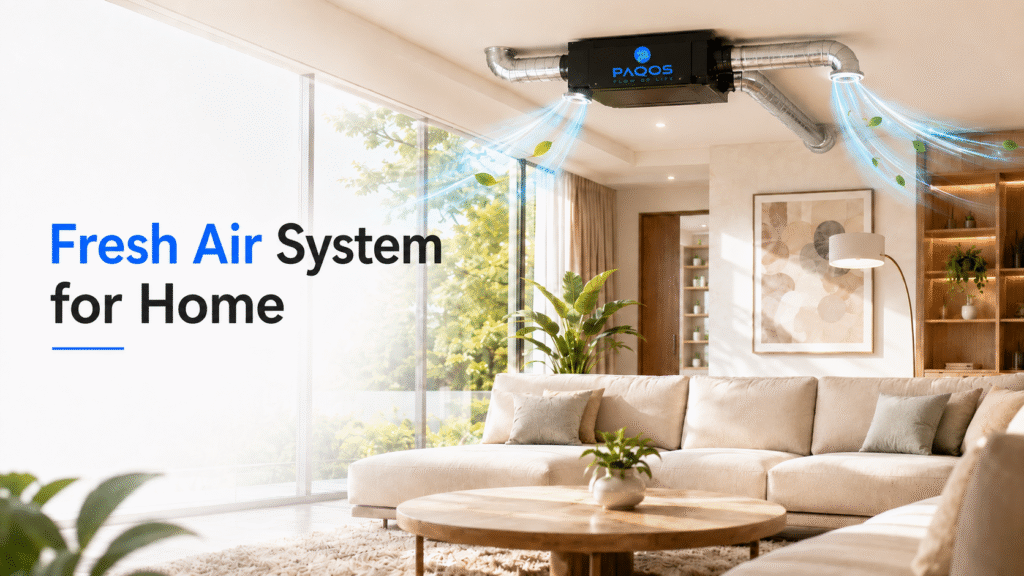
These three solutions are often confused, but each performs a distinct function:
| Solution | Primary Function |
|---|---|
| Indoor Fresh Air System | Introduces planned outdoor air and supports whole-home air exchange |
| Air Purifier | Filters particles from the air already present inside a room |
| Exhaust Fan | Removes air from a specific area, such as a kitchen or bathroom |
| Air Conditioner | Controls indoor temperature and, depending on the setup, humidity |
These solutions can complement one another, but they are not interchangeable. An air purifier does not bring in outdoor air—it recirculates and filters the same indoor air. An exhaust fan removes air from one zone but does not replace it with filtered fresh air. An Indoor Fresh Air System addresses the fundamental need: introducing and distributing outdoor air in a controlled, filtered manner throughout the home.
How to Plan the Right Indoor Fresh Air System
Choosing a system without assessing the property first often leads to poor results. A proper planning process should account for:
- Home size and layout, including ceiling height and room positions
- Number of occupants and hours of occupancy per room
- Existing AC or HVAC infrastructure and how the fresh air system will integrate
- Location of the outdoor air intake and proximity to pollution sources
- Required filtration level based on local outdoor air quality
- Available duct routes and false ceiling space
- Noise expectations for bedrooms and quiet areas
- Balance between incoming and outgoing airflow to avoid pressure imbalances
- Maintenance access and filter replacement schedules
A well-planned Indoor Fresh Air System delivers consistent performance. A poorly planned one creates new problems while solving none of the original ones.
Plan Ventilation Before Completing Your Interiors
Fresh air planning is far easier—and far less disruptive—when it happens before construction or renovation is complete. Ideally, ventilation should be considered during:
- Architectural planning and floor layout design
- Home construction or major renovation
- False ceiling and duct installation
- AC and electrical planning
Once false ceilings are sealed and walls are finished, routing ducts becomes significantly more complex and expensive. Early planning also allows vent positions to be integrated cleanly into the interior design, rather than appearing as afterthoughts.
For homeowners looking at complete water and air solutions from a single, integrated partner, PAQOS positions its offering as a cohesive approach to home environment management—combining air planning with broader infrastructure solutions.
Plan Your Indoor Fresh Air System with PAQOS
PAQOS approaches fresh air planning as an engineering and consultation process, not simply a product transaction. The team works with homeowners, architects, and builders to:
- Understand the home layout and occupancy patterns
- Review existing ventilation conditions and gaps
- Plan intake locations, filtration specifications, and air distribution routes
- Coordinate the system design with interior finishes and existing AC infrastructure
- Recommend a configuration suited to the property’s specific requirements
- Support installation coordination and long-term maintenance planning
PAQOS offers dedicated indoor fresh-air and ventilation solutions for residential environments, built around the understanding that every home is different and no single configuration fits all.
A Comfortable Home Needs More Than Cooling
Modern homes are more enclosed than ever before. Air conditioners manage temperature effectively—but they do not replace the function of proper ventilation. Fresh-air planning supports comfort, airflow consistency, and indoor freshness in ways that cooling alone cannot achieve.
The right Indoor Fresh Air System is not a generic product off a shelf. It is a solution designed around your home’s layout, occupancy, existing infrastructure, and local conditions. Getting that design right from the start is what makes the difference between a system that works and one that doesn’t.
Talk to PAQOS for fresh indoor air planning.
Frequently Asked Questions
Does an AC bring fresh air into a room?
Most standard split air conditioners primarily recirculate the indoor air that is already present in the room. They cool and condition that air, but do not routinely introduce sufficient fresh outdoor air. Some specialized AC units or ducted systems may have provisions for outdoor air intake, but this varies by system type and configuration. For consistent fresh air supply, a dedicated ventilation system is the more reliable solution.
Is an air purifier the same as a fresh air system?
No. An air purifier filters the air already inside a room, removing particles such as dust, allergens, and some pollutants from the recirculated indoor air. An Indoor Fresh Air System is designed to introduce and distribute outdoor air into the home in a controlled, filtered manner. The two serve different purposes and can be used together for more comprehensive indoor air management.
Do apartments need an Indoor Fresh Air System?
The need depends on the apartment’s layout, window access, number of occupants, and local outdoor conditions. Apartments with limited windows, fewer open sides, or residents who keep windows closed due to heat, dust, or noise are particularly likely to benefit from planned mechanical ventilation. High-occupancy apartments with enclosed kitchens and bathrooms are also strong candidates.
Can a fresh air system work with an existing AC?
Yes, in most cases an Indoor Fresh Air System can be planned and installed alongside an existing cooling system. The two serve complementary functions—cooling and ventilation—and can often share duct infrastructure or be routed separately, subject to a technical assessment of the property. PAQOS evaluates existing AC setups as part of the planning process.
When should homeowners plan their ventilation system?
The best time to plan a ventilation system is during construction, major renovation, false-ceiling design, or AC installation. Planning at this stage makes duct routing, vent positioning, and system integration significantly easier and less disruptive. That said, retrofitting a fresh air system into an existing home is also possible with proper assessment—it simply requires more careful planning around existing infrastructure.