

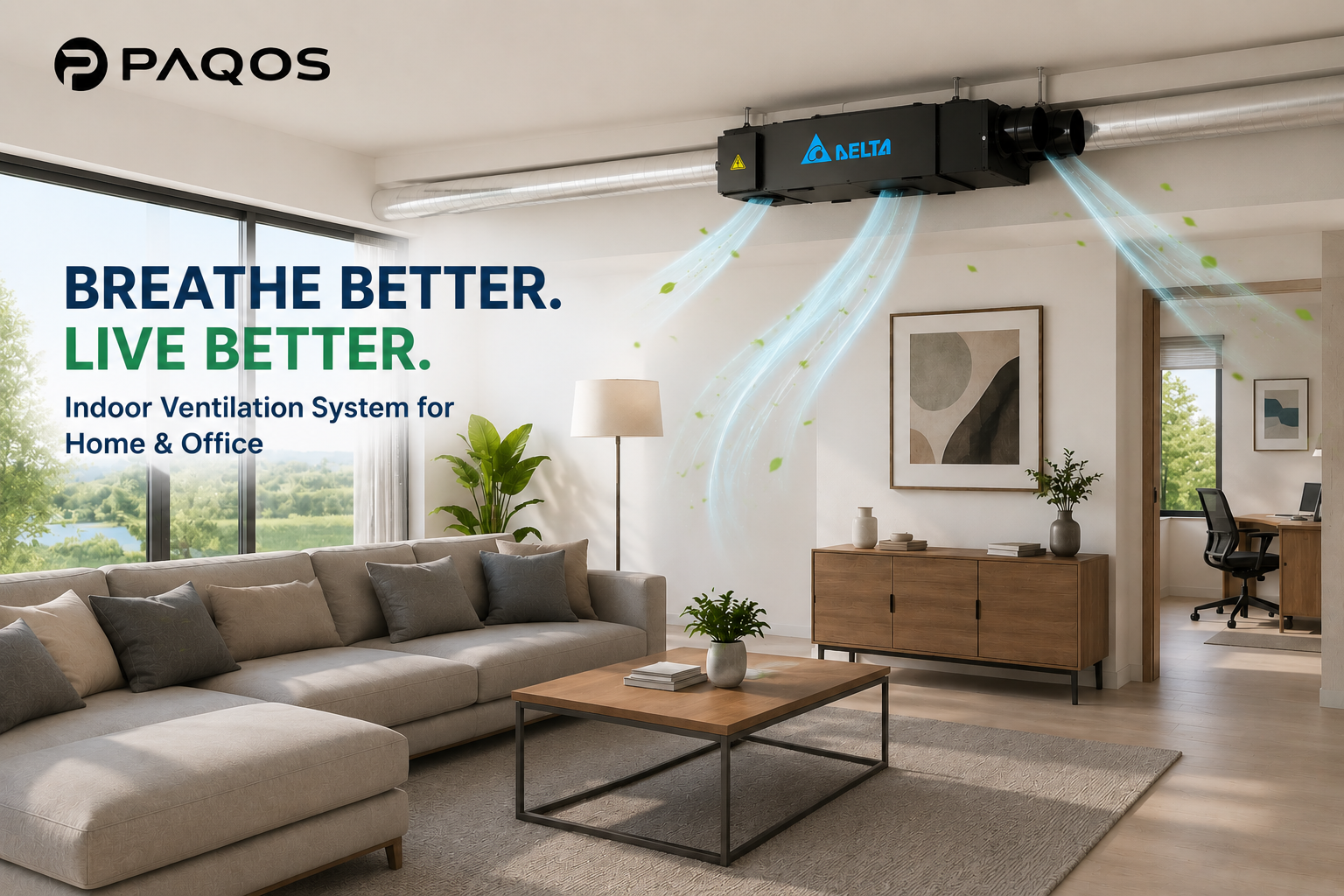
Have you ever sat inside your home or office for a few hours and suddenly felt heavy-headed, tired, or unable to focus — even though you hadn’t done anything tiring? Most people blame it on stress or the heat. But the real reason is often much simpler: the air inside your space is stale, polluted, and slowly running out of oxygen.
This is where a ventilation system for home makes all the difference.
In this guide, we’ll break down everything you need to know — what a ventilation system actually does, why Indian homes and offices desperately need one, and how to pick the right system for your space.
What Is a Ventilation System for Home?
A ventilation system for home is a mechanical setup that continuously pushes out old, polluted indoor air and replaces it with fresh, filtered air from outside. Think of it as the lungs of your building — quietly working in the background so everyone inside can breathe clean, healthy air.
Unlike a ceiling fan or an air conditioner, a ventilation system doesn’t just circulate the same stale air. It actually replaces it with fresh outdoor air — filtered to remove dust, PM2.5 particles, bacteria, and allergens.
There are different types of ventilation systems available in India today:
- Exhaust ventilation — pulls stale air out of the building
- Supply ventilation — pushes fresh air in from outside
- Balanced ventilation — does both simultaneously
- ERV (Energy Recovery Ventilator) — the most advanced type, which also recovers energy from outgoing air so your electricity bill doesn’t spike
Why Indoor Air Is More Polluted Than You Think
Most people assume the air inside their home is cleaner than outside. That assumption is wrong — and in Indian cities, it’s dangerously wrong.
According to studies on indoor air quality India, the air inside sealed homes and offices can be 2 to 5 times more polluted than outdoor air. Here’s what’s silently building up inside your walls:
- PM2.5 and dust — enters from outside, settles inside, and never leaves without ventilation
- Carbon dioxide (CO₂) — exhaled by every person in the room; rises rapidly in closed spaces
- VOCs (Volatile Organic Compounds) — released from new furniture, paints, carpets, and cleaning products
- Mold and moisture — builds up in bathrooms, kitchens, and poorly ventilated rooms
- Cooking smoke — spreads through the house and lingers for hours
In cities like Delhi, Gurugram, Noida, and Faridabad, outdoor AQI regularly crosses 300–400 in winter. Without a proper ventilation system for home, all of that pollution seeps inside and stays there — because your sealed windows and walls trap it in.
5 Signs You Urgently Need a Ventilation System
You don’t need an air quality monitor to know your indoor air is bad. Here are five honest signs to watch for:
1. Stuffy or musty smell indoors That “closed room” smell is actually CO₂ and stale air. A ventilation system for home eliminates it completely.
2. Fogged or condensation on windows Morning condensation is a sure sign of excess humidity — which leads to mold if not addressed.
3. People fall sick frequently Dust, allergens, and bacteria circulating in closed air cause frequent colds, coughs, and allergic reactions — especially in children and elderly family members.
4. Tiredness and lack of focus High CO₂ levels cause drowsiness. If your team feels sluggish by mid-afternoon, or if family members seem constantly fatigued, poor indoor air quality India could be the reason.
5. Visible mold or damp patches on walls Once you see mold, ventilation is overdue. It spreads fast and causes serious respiratory issues.
The Best Solution: ERV — Energy Recovery Ventilator
Among all types, the ERV system for office and home use is the gold standard — and for good reason.
An ERV system works by exchanging stale indoor air with fresh outdoor air through a heat exchange core. Here’s the smart part: it recovers up to 70–80% of the energy from the outgoing air and uses it to pre-condition the incoming air. This means:
- In summer, incoming hot air gets pre-cooled by the outgoing cool indoor air
- In winter, incoming cold air gets pre-warmed before entering your room
- You get continuous fresh air — without a spike in your electricity bill
For Indian weather — with brutal summers, humid monsoons, and cold Delhi winters — this is the most practical and cost-effective ventilation solution available ventilation system for home.
Paqos Delta ERV System — What You Get
Paqos offers Delta ERV systems for homes, apartments, offices, schools, and commercial buildings across Delhi NCR. Here’s what makes these systems stand out:
- 3-Stage High-Efficiency Filtration — removes PM2.5, dust, pollen, and bacteria
- Dual Brushless DC Motors — near-silent operation, low power consumption
- Whole-building fresh air supply — not just one room, the entire space
- Smart CO₂ sensors — automatically adjusts airflow based on how many people are in the room
- Easy ventilation system installation — works for new construction and existing buildings
Whether you live in a 2BHK flat in Gurugram or manage a corporate office in Noida, Paqos has a system sized for your space ventilation system for home.
Ventilation System for Home vs. Air Purifier — What’s the Real Difference?
This is the most common question we get. Here’s a simple, honest comparison:
| Feature | Air Purifier | Ventilation System (ERV) |
|---|---|---|
| Brings in fresh outdoor air | ❌ No | ✅ Yes |
| Removes CO₂ | ❌ No | ✅ Yes |
| Filters dust & PM2.5 | ✅ Yes | ✅ Yes |
| Controls humidity | ❌ No | ✅ Yes |
| Covers whole home or office | ❌ One room only | ✅ Entire building |
| Energy efficient | Moderate | High (recovers energy) |
| Replaces stale air with fresh air | ❌ No | ✅ Yes |
An air purifier cleans the same recycled air over and over. A ventilation system for home actually replaces that old air with fresh outdoor air — filtered, conditioned, and energy-efficient. For complete indoor air health, there is no substitute ventilation system for home.
Who Needs a Ventilation System?
Homeowners and Families
If you live in a modern apartment with sealed double-glazed windows, your home barely breathes. Opening windows means letting in pollution and noise. A fresh air system for home solves this perfectly — you get clean fresh air without the dust, pollution, or noise from outside ventilation system for home.
Especially important for:
- Families with young children or infants
- Elderly members with asthma, bronchitis, or other respiratory conditions
- Newly renovated homes (high VOC levels from paint and furniture)
- Homes with pets
Offices and Commercial Spaces
Research from Harvard shows employees in well-ventilated offices score 61% higher on cognitive tasks than those in poorly ventilated ones. Better air = sharper thinking = better productivity.
If your team gets headaches by afternoon, or if meetings in a closed conference room always feel draining — that’s poor indoor air quality India at work.
The ERV system for office spaces is especially powerful because it handles the CO₂ buildup that happens quickly when many people are in one room. It’s ideal for corporate offices, co-working spaces, schools, clinics, hotels, and restaurants.
Ventilation System Installation — What to Expect
Many people hesitate because they think ventilation system installation requires massive civil work. The reality is simpler than you think.
At Paqos, our installation process involves:
- Free site assessment — our team visits your home or office and measures the space
- Custom system design — we recommend the right ERV model and airflow capacity for your space
- Clean installation — minimal civil work; most installations are done in 1–2 days
- Testing and commissioning — we verify airflow, filtration, and CO₂ sensors before handover
- After-sales support — access to the Paqos Care App for complaints and tracking
We’ve done ventilation system installation for homes, housing societies, schools, hospitals, corporate offices, and restaurants across Delhi NCR. Every installation is backed by our 30+ years of experience.
The Cost of NOT Having a Ventilation System
People often delay this decision because of the upfront cost. But consider what poor indoor air quality actually costs you:
- Doctor visits and medicines for respiratory infections
- Lost productivity at work from fatigue and brain fog
- Damage to walls and furniture from mold and moisture
- Higher electricity bills from an AC working harder in humid, unventilated rooms
- Long-term health impact on children growing up in poor air quality
A quality ventilation system for home is a one-time investment that pays back in health, productivity, and lower maintenance costs for years.
Why Choose Paqos?
Paqos has been India’s trusted name in air and water solutions since 1997 — over 30 years of expertise. With 85,000+ satisfied customers across Delhi NCR, we understand that every home and business has unique needs.
Here’s what makes us different:
- Free consultation — we assess your space before recommending any product
- Genuine products — we partner with Delta for world-class fresh air system for home solutions
- Expert installation team — trained, certified technicians handle everything
- Paqos Care App — track complaints and service requests on your phone
- End-to-end support — from first consultation to annual maintenance
We don’t just install systems. We make sure you breathe better, every single day.
Final Thoughts
The quality of air you breathe indoors directly affects your health, energy levels, sleep, and productivity. In India — especially in cities like Delhi, Gurugram, Faridabad, and Noida — indoor air quality is a daily health challenge.
A ventilation system for home is no longer a luxury. It’s a necessity for every modern apartment, house, and office that cares about the people inside.
If you’re ready to breathe cleaner, healthier air — Paqos is here to help you every step of the way.
📞 Call us: (+91) 08010-254-254 🌐 Visit: paqos.in 📧 Email: sales@paqos.in 📍 Serving: Delhi, Gurugram, Noida, Faridabad, Ghaziabad & all of Delhi NCR